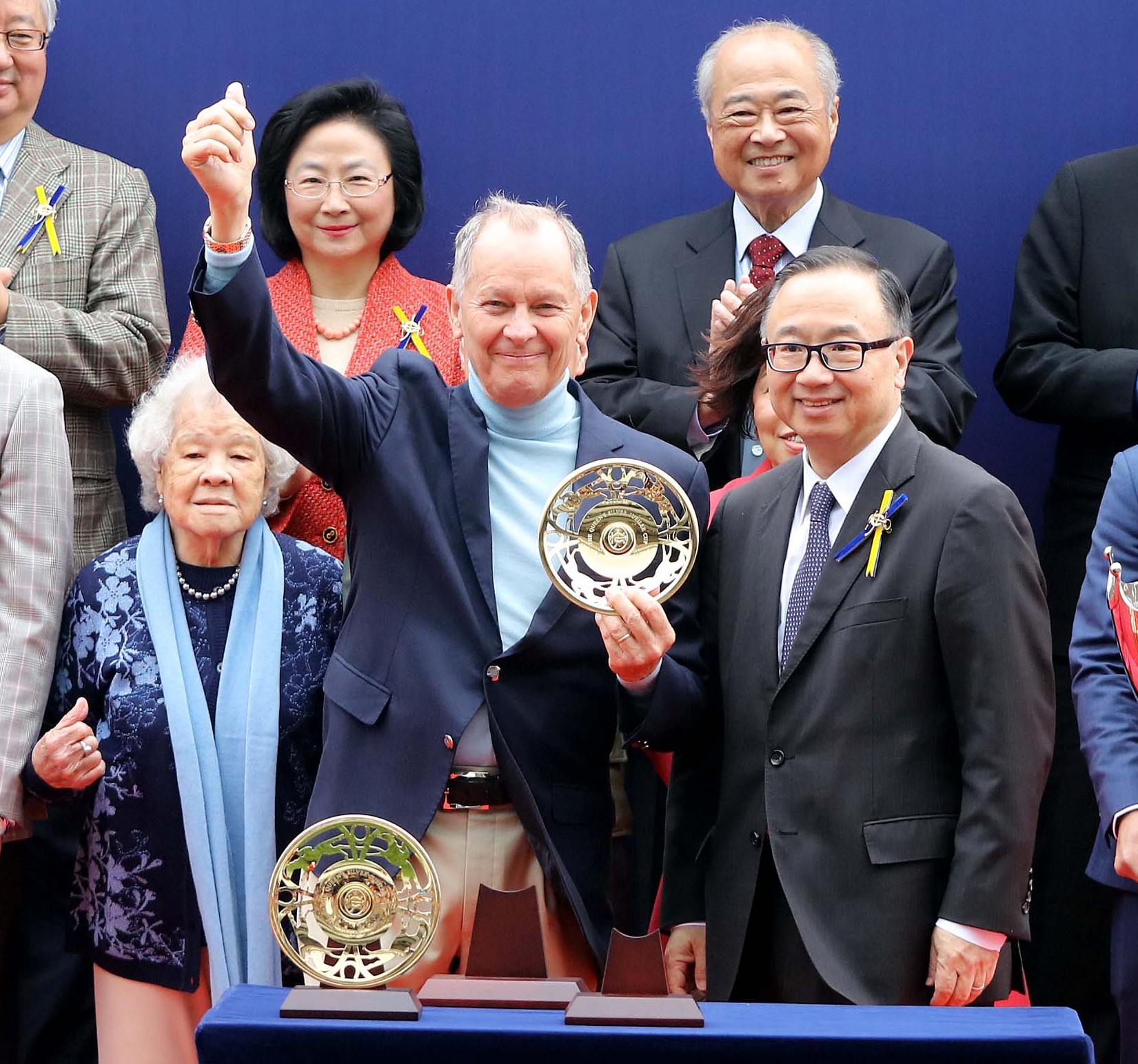
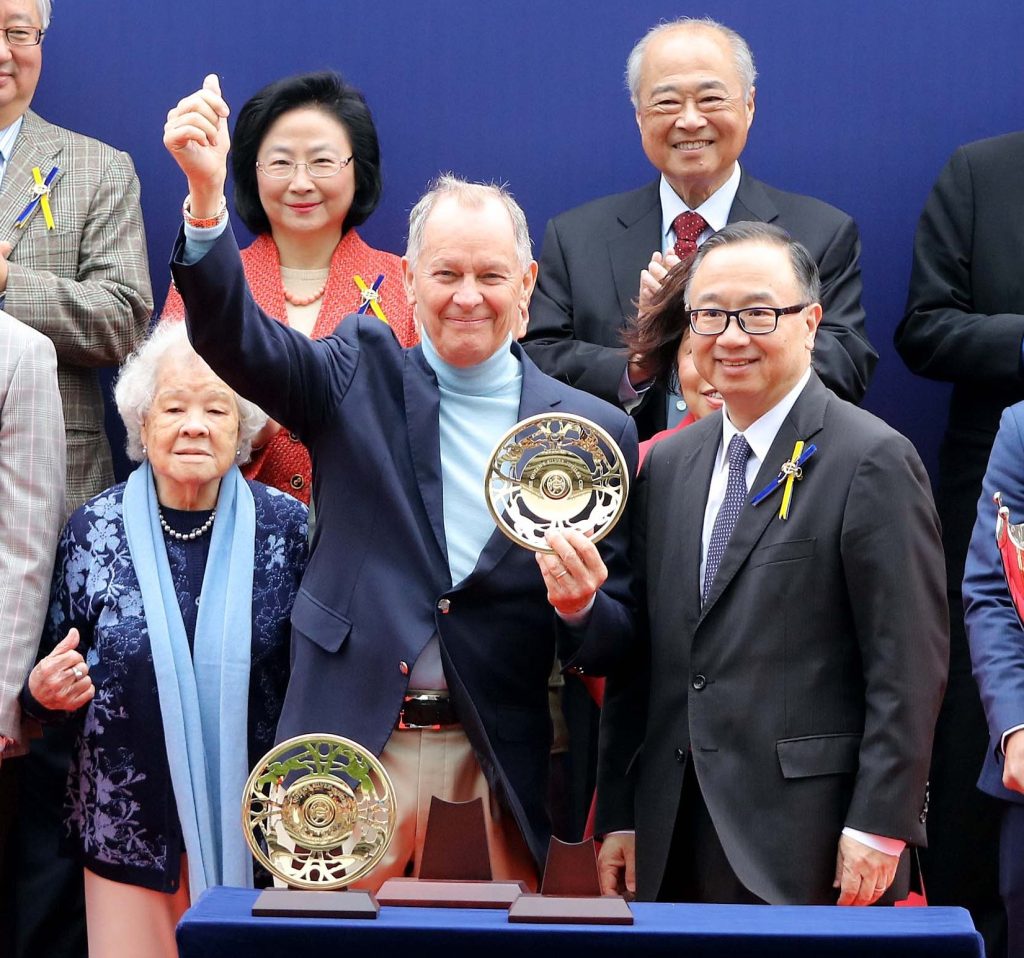
John Moore was born into racing royalty, but the extraordinary reputation he built in Hong Kong was entirely his own. Over a training career spanning 35 seasons, the Australian became a seven-time champion trainer, saddled a record six Hong Kong Derby winners and prepared some of the finest horses ever seen at Sha Tin.
By the time his Hong Kong training career ended in July 2020, Moore had accumulated a record 1,735 victories and almost HK$2.1 billion in prize money. His record also included 36 Group 1 triumphs, four of them achieved overseas, and 61 victories in races carrying either Group 1 or the former Hong Kong Group 1 status. Those achievements earned him a reputation that followed him throughout the latter part of his career: Hong Kong’s “big-race king”.
Moore’s connection with racing began almost as soon as he could walk. His father, George Moore, was one of Australia’s greatest jockeys, winning major races in Australia, Britain, France and the United States before becoming a dominant trainer in Hong Kong. John and his younger brother Gary grew up riding horses and competing against each other in pony races on the family property. Gary would later become an internationally successful jockey and trainer, while John gradually found his own place within the family profession.
John Moore arrived in Hong Kong in the spring of 1971, during the closing months of the amateur racing era. Although an opportunity existed for him to join his father’s operation in France, Moore sensed that professional racing in Hong Kong was about to enter an important period of development and decided to remain in the city.
His early life in Hong Kong was very different from the wealthy and internationally recognised racing industry he would later help create. Moore lived in a small room on the Kowloon side and travelled across Victoria Harbour each morning in a walla-walla water taxi. He rode his first Hong Kong winner on Connetable and completed his brief jockey career with 23 victories from 304 rides between March 1971 and the 1976/77 season.
Moore was never destined to become a great jockey in the mould of his father or brother. Instead, much of his value to the family stable came as a lead work rider and an observer. He developed an intense interest in how horses were prepared, fed and brought to peak condition.
Before becoming a trainer, Moore broadened his education by studying the methods of several internationally renowned horsemen. He spent time with Kevin Prendergast in Ireland, Colin Hayes in Australia and Charlie Whittingham in the United States. Whittingham’s feeding system made a particularly strong impression on him. Moore carefully recorded the details in a notebook and later introduced new approaches to nutrition in his father’s stable.
When George Moore retired after undergoing heart surgery in 1985, John took over the stable. The transition could hardly have been more successful. He trained 48 winners in his first season and was immediately crowned champion trainer.
Moore would later acknowledge that he inherited a powerful operation from his father, but sustaining that success required him to develop his own methods. He had to learn stable management, race programming and the difficult art of identifying horses overseas that could adapt to Hong Kong’s demanding racing environment. Over time, those abilities became the defining strengths of his career.
Moore’s willingness to search internationally for better horses helped transform his stable. Working with bloodstock agent John Foote, he initially concentrated on Australia. Distinction, sourced through that partnership, won the Stewards’ Cup in 1987. Motivation was imported from Argentina and captured the 1993 Hong Kong Invitational Cup, the race now known as the Hong Kong Cup.
Moore later expanded his search to the United States and Europe. He attended major meetings and sales in Britain and Ireland, inspected horses personally and built an international network of agents, trainers and owners. Rather than relying entirely on reputation or race records, he looked for horses whose physique, temperament and racing style appeared suitable for Hong Kong.
The clearest measure of Moore’s success was his remarkable record in the Hong Kong Derby. He won the city’s most prestigious domestic race six times, more than any other trainer in the modern era.
His Derby winners were Makarpura Star in 1995, Viva Pataca in 2006, Collection in 2009, Designs On Rome in 2014, Werther in 2016 and Rapper Dragon in 2017. The victories covered more than two decades and demonstrated his ability to identify and develop outstanding four-year-olds from several different racing jurisdictions.
Makarpura Star was Moore’s first genuine stable champion, arriving almost ten years after he began training. Viva Pataca, purchased from Britain for owner Stanley Ho, became one of the great middle-distance horses of his era. Collection produced a devastating performance in the 2009 Derby, while Designs On Rome defeated stablemate Able Friend in a stirring renewal five years later.
Werther completed the Derby and Queen Elizabeth II Cup double in 2016. Rapper Dragon then made history in 2017 by becoming the first horse to sweep all three races in the Four-Year-Old Classic Series—the Hong Kong Classic Mile, Hong Kong Classic Cup and Hong Kong Derby.
Despite his early dominance in the trainers’ championship, Moore had to wait until 2007 for his first victory in a race carrying internationally recognised Group 1 status. That breakthrough arrived in spectacular fashion when Able One won the Champions Mile and Viva Pataca captured the Queen Elizabeth II Cup. Remarkably, the same pair returned three years later and won the two races again in 2010.
The 2014 season further established Moore as an international force. Sterling City won the Dubai Golden Shaheen on Dubai World Cup night, providing the stable with a major victory outside Hong Kong. At Sha Tin that December, Designs On Rome narrowly defeated former stablemate Military Attack in the Hong Kong Cup before Able Friend produced a dominant performance in the Hong Kong Mile.
Moore described that Hong Kong International Races double as the greatest result of his career at the time. It showcased both sides of his training ability: Designs On Rome was a determined middle-distance performer, while Able Friend possessed exceptional acceleration and became one of Hong Kong’s most celebrated milers.
Moore’s list of champions was extraordinary. Makarpura Star, Viva Pataca, Military Attack, Designs On Rome, Able Friend, Werther, Rapper Dragon and Beauty Generation all became defining horses of their respective seasons. Eight individual Moore-trained horses collected a combined nine Hong Kong Horse of the Year titles, with Beauty Generation winning the award twice.
Beauty Generation was perhaps the finest example of Moore’s ability to transform an imported horse. Previously raced in Australia as Montaigne, he initially appeared to be a possible Derby contender. Moore ultimately decided that the horse was better suited to shorter distances and developed him into a dominant front-running miler.
Under Moore’s care, Beauty Generation won eight Group 1 races, collected consecutive Horse of the Year titles and became the first Hong Kong-trained horse to earn more than HK$100 million. He surpassed Viva Pataca as Hong Kong’s record prize-money earner and, at his peak, established himself among the world’s highest-rated racehorses.
Moore’s success was based on more than purchasing expensive imports. He was known for his attention to detail, his relentless work ethic and his ability to have horses reach their best condition for major races.
At trackwork, Moore continued to use his own stopwatch, binoculars and handwritten records even as modern technology became more widely available. Douglas Whyte, who observed Moore closely before becoming a trainer, highlighted his ability to time a horse’s preparation so that it reached peak condition on the most important day.
Moore rejected the idea that every horse should follow the same programme. He studied each animal individually, adjusting its exercise, feeding and race schedule according to its physical condition and personality. His stable was large enough to compete at the highest level but remained manageable enough for him to know his horses closely.
That individual approach was especially important in Hong Kong, where imported horses must adapt to a new climate, training environment and style of racing. Many expensive arrivals failed to reproduce their overseas form, but Moore repeatedly turned imports from Europe, Australia, New Zealand and other regions into local champions.
His influence also extended to the next generation. Future champion trainer Frankie Lor worked as an assistant to Moore as well as John Size before receiving his own licence. Douglas Whyte similarly studied Moore’s operation before establishing his stable. Through his staff, assistants, bloodstock network and international connections, Moore helped pass on knowledge accumulated across five decades in racing.
Moore secured seven Hong Kong trainers’ championships in total. His final title came in the 2014/15 season, when Able Friend was at the height of his powers. He also became the first Hong Kong trainer to reach 1,000 winners and the first to exceed HK$1 billion in prize money. By the end of his career, both figures had risen far beyond those original landmarks.
Hong Kong racing’s compulsory retirement rules brought Moore’s local training career to an end on 15 July 2020, when he was 70. His final runner was Sunny Boy in the last race of the season at Happy Valley. The following evening, the Hong Kong Jockey Club presented Moore with a Lifetime Achievement Award in recognition of his contribution to the sport.
John Moore began his Hong Kong journey as a young rider travelling across the harbour to the racecourse. He left as the city’s record-breaking trainer, the winner of seven championships, the handler of six Derby winners and the architect behind an almost uninterrupted succession of champion racehorses.
His father had helped bring international prestige to Hong Kong during the early professional era. John Moore carried that legacy much further, sourcing horses from around the world, winning major races at home and overseas and demonstrating that Hong Kong-trained runners could compete at the highest level.
Moore was more than a successful trainer. With his Panama hats, safari suits, stopwatch and unmistakable confidence, he became one of the most recognisable personalities in Hong Kong racing. Above all, however, it was his record on the biggest days that defined him. When the prize was most valuable and the pressure at its greatest, John Moore’s horses were so often ready to deliver.